Evaluative
Evaluative
Problem
Looking at the problem statement we can easily tell it’s a polynomial evaluation problem. 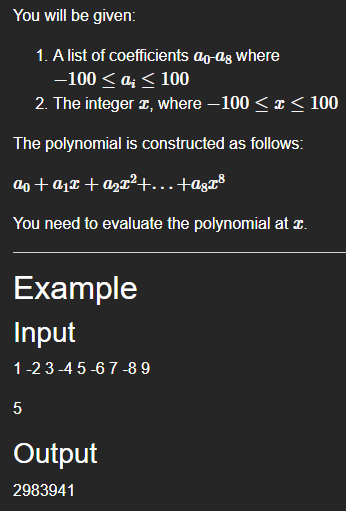
Approach
Bruteforce
We could calculate polynomials with an O(n^2) approach. Nested for loops, where the outer loops add the coefficient to results and inner loop calculates power of x.
Horner’s Rule
Horner’s rule is an O(n) appraoch. It essentially opens up the calculation in this manner: From: ax^2 + bx + 1 To: x(ax + b) + 1
Solution
One thing to consider is the possibility of result getting too large to store in a 32bit space. Hence, we use long long int to store upto 64bit of integer value.
The coefficients are inserted in order x^0 to x^(n-1), hence, we store from the last index to first index.
1
2
3
4
5
6
7
8
9
10
11
12
13
14
15
16
17
18
19
20
21
22
23
24
25
26
27
28
29
30
#include <iostream>
using namespace std;

long long int horner(int coeff[], int x){
    long long int result = coeff[0]; //start from the inner most bracket (ax + b). store coefficient `a` in results

    for(int i=1; i<9; i++){
        result = result*x + coeff[i]; //do (ax + b)
        //suppose c = (ax + b)
        //in next iteration it does c*x + d
    }

    return result;
}

int main() {

    int coeff[9]; //array to store coefficient. each coefficient at ith index represents the coefficient of ith term.
    int x;

    //start from last index (x^0th) term to first index (x^n-1) term.
    for(int i=8; i>=0; i--){
        cin >> coeff[i];
    }
    cin >> x;

    cout << horner(coeff, x);

    return 0;
}
This post is licensed under CC BY 4.0 by the author.